
If Xi Jinping can establish control over the PLA Ground Force, relations between India and China will settle down to an even keel. The next few weeks will show whether Xi has finally succeeded in gaining control over the PLA Ground Force. That could bring about the substantive shift in India-China relations that both our leaders have been working for, observes Ambassador Prabhat Shukla.

The arrival a couple of days ago of a Chinese nuclear submarine for the first time in Karachi port, coinciding with a Chinese military delegation's visit, points to Pakistan's importance for China, says former R&AW officer Jayadeva Ranade.
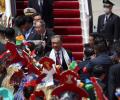
Wang Yang and Xi Jinping's visits signal the beginning of a major Chinese push to bring about a transformation of Tibet, observes Jayadeva Ranade, the distinguished China expert and retired RA&W officer.

'Tibetans will participate in future conflicts with India (in all probability, some were already present in Galwan).' 'As nobody in India would like to have a deadly fight with Tibetan soldiers and officers, the issue needs to be closely followed,' observes Claude Arpi.

A visit to Tibet appears to have become the new touchstone for expressing fealty to Xi Jinping, observes Jayadeva Ranade, the retired senior RA&W officer and distinguished China expert.

Xi has called on Chinese border troops to enhance their capabilities in border defence and control to forge a "great wall of steel" along the country's borders, it said.
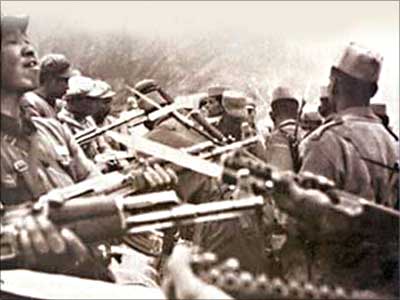
From March 1959 to March 1962, the PLA fought 12 major battles in central Tibet which was seen as an opportunity to train China's soldiers, notes Ajai Shukla.

Samdong Rimpoche's visit to China materialised against the backdrop of strained India-China relations consequent to the face-off between Indian and Chinese troops at Doklam, says former RAW officer Jayadeva Ranade.
The first priority for the new Tibetan administration in Dharamsala should be to look at Tibetan recruitment in the PLA, suggests Claude Arpi.

On December 10, Kissinger began to encourage the Chinese to take action against India: 'If the People's Republic were to consider the situation on the Indian subcontinent a threat to security, and if it took measures to protect its security, the US would oppose efforts of others to interfere with the People's Republic.' On the 50th anniversary of India's greatest military victory, Claude Arpi recalls how the US suggested that China intervene militarily on Pakistan's side.

However, Denmark said it is difficult to conclude on the real intention behind this.
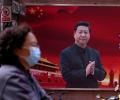
China has not limited the 'battle' to the diplomatic field alone; the People's Liberation Army has become aggressive on the ground too. The recent 'fights' in Northern Sikkim and Ladakh are part of the pattern, asserts Claude Arpi.

What was the need for Xi Jinping, general secretary of the Chinese Communist Party, President of the People's Republic of China and Chairman, Central Military Commission, to don the new role of Commander in-Chief? Does this mean that the most powerful Chinese leader since Mao faces numerous threats from within the Communist Party?

'Clarifying that modernisation of national defence and armed forces should be completed by 2035, Xi Jinping asserted the goal is to make the People's Liberation Army a "world class force" that "can fight and win" by 2050,' points out former RAW officer Jayadeva Ranade.

'We rarely choose to fight when the threat is still a nascent threat. When we do fight, we fight when the invaders reach Panipat and are preparing to knock on the gates of Delhi.'

No account of the 1962 war could be complete without Maxwell's authoritative analysis. Which is why we are reprinting this article which was run on Rediff.com in June 2001.
 © 2026 Rediff.com - Advertise with us - Disclaimer - Privacy Policy - Sitemap - Feedback - About us - Terms of use - Grievances